
The walls of a maze are hidden, but you can draw them in as you work them out. Marking is free, never costs a heart, and turns a board full of numbers into a map you can walk.
Three taps on a border
Every border between two tiles can carry one note of yours. Tap it to step through the three states:
- Once: your own wall. The island's wall in cream, the colour of the numbers, with an amber line along the middle, so you can tell it from a wall the game has shown you.
- Twice: a dotted mark. Three short cream dashes lying flat on the border: "I think it is open here".
- Three times: nothing. The border is clear again.
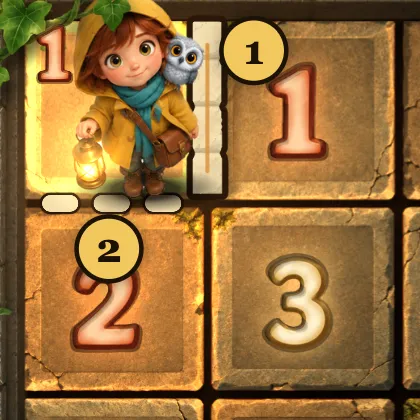
- Your own wall (one tap).
- A dotted mark (two taps).
Why your own wall protects you
To your hero, your own wall is a wall. Tap the tile behind it and nothing happens: the wall flashes, your hero leans towards it and back, and you hear a soft click. No step is counted, no heart is lost and nothing is revealed. When your hero walks along a row or column by herself, she stops in front of your wall.
That is the point of marking: once you have reasoned that a wall must be somewhere, mark it, and a slip of the finger can never cost you a heart there.
The dotted mark changes nothing
A dotted mark is a note for you, not for the game. Your hero crosses it like any border: if it really is open she steps through, and if a hidden wall is there after all she bumps into it and you lose a heart. Use it for borders you have proved open but not walked yet.
Tapping between tiles
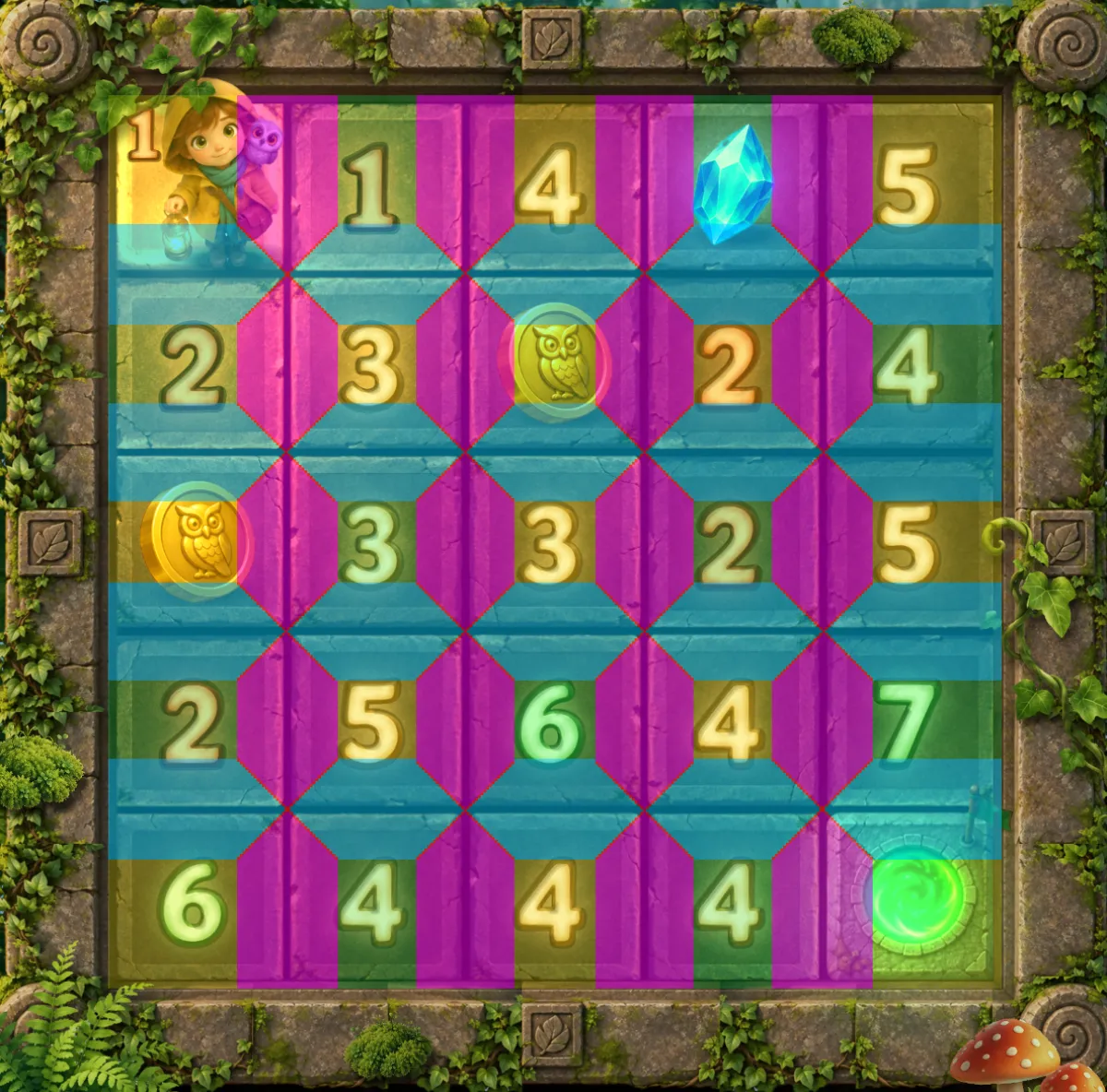
You do not have to hit the thin line between two tiles. Each border has a band of a little over a quarter of a tile on each side of it; a tap there marks the border, and a tap in the middle of a tile moves your hero. Near a corner the four borders share the space evenly.
Walls and passages the game shows you
Some borders become certain, and then you can no longer mark them:
- A wall you bumped into stands as a low wall in the island's own stone, dark and solid.
- A wall or a passage shown by a hint looks the same: a stone wall, or footprints.
- Every border you have walked across gets small footprints: a proven passage.
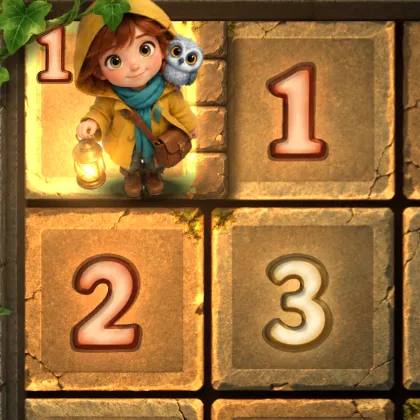
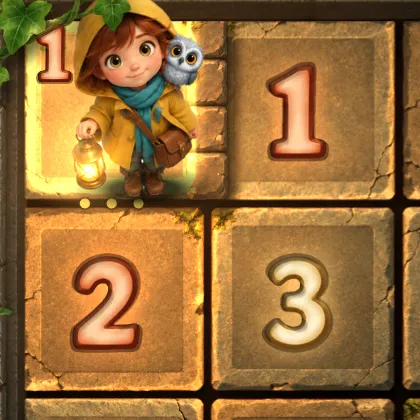
A hint opens a border next to your hero even when your own mark is on it: the truth replaces the guess. When you win, every wall you did not find is shown for a moment before the results.
A good habit
Mark first, walk second. Before every step, ask whether the border is proved open: by a number, by footprints, or by a wall you have ruled out. If it is only likely, look for another number that settles it. Reading the numbers shows the reasoning on a real board.